
Process settings
Run to defined parameters to reduce variation in setup and operation.
STAMPING, EXPLAINED
Progressive-die housings
How forming affects cost and quality.
From sheet to shell
A press and die progressively shape sheet metal. Deep drawing is one such operation: it turns a flat blank into a shell with depth.
Uncoil, level and feed the strip.
The feeder advances the steel strip into the die, supplying material to the following stations.
Start with coilEach station forms the housing a little further.
The strip advances through the die with each press stroke. Blanking, drawing and forming take place in sequence, reducing transfers between separate machines.
Form in one diePunch holes and side features.
After drawing, punches form holes and side features in the shell, reducing the work sent to separate machines.
Pierce in the dieCut the required threads in the die.
Tapping is built into the die so threads are cut during the press cycle, saving a separate setup and transfer.
Tap in the dieCheck against requirements and trace by batch.
Fewer setups simplify process control. First-piece checks, in-process inspections and critical dimension checks precede packing and delivery by batch.
Verify each batchThe photographs show sectioned samples at successive stages. The numbers are the study’s original markings. Production housings are formed whole. This is a general process: some parts also require cleaning, surface treatment or local machining.
One housing, two manufacturing routes
A progressive die can combine several forming and feature-making operations in one tool.
Each machining operation eliminated also saves machine time, labor, fixturing and transfers.
Press cycle on a TONQIU project
Each added operation incurs machining costs and requires handling, queuing and transfer between setups.
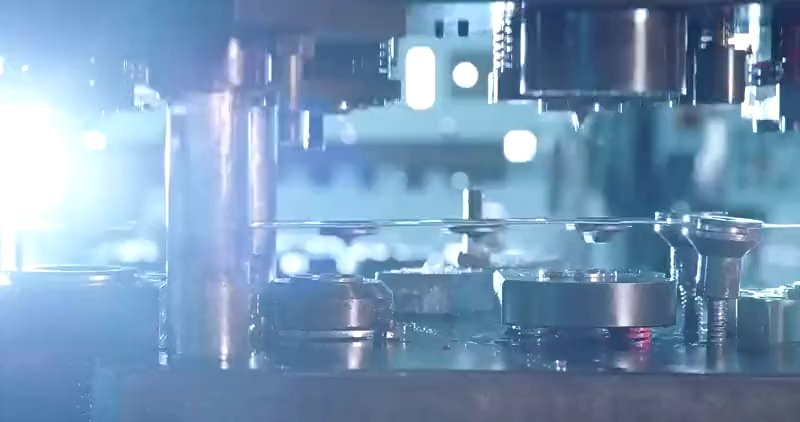
In this housing example, the coil feeds into the press and the die forms the finished housing in one continuous sequence.
Repeatable forming and TONQIU process control
A progressive die uses fixed stations and consistent strip positioning to reduce variation from one operation to the next.
TONQIU controls process settings, inspects parts during production and maintains the tooling to sustain that consistency across batches.
The strip advances through stations in the same die without removal and reclamping between operations.
We manage operating conditions, check the results and maintain the tooling throughout production.
Run to defined parameters to reduce variation in setup and operation.
Check critical dimensions and formed features to detect and correct deviations during production.
Monitor wear and alignment to keep tooling in stable working condition.
Under IATF 16949, process settings, in-process inspections and die maintenance are managed throughout production.